


Baby Music Classes in Austin: Is Your Baby Too Young?


You look at your tiny baby—weeks, maybe months old.
They’re still mostly sleeping, feeding, crying, and endlessly entertained by the ceiling fan.
And you think: Can my baby really get anything out of a mommy-and-me music class yet?
You wouldn’t be the first, or last, to ask.
Waiting until your baby can sit up, clap, crawl, or at least look a little more interested in what’s happening around them before starting a bilingual music class seems like common sense.
But what if waiting for your baby to look ready means missing some of the time when their brain is most ready?
Your baby does not have to perform for learning to be happening.
Before first words, before clapping, and long before obvious participation, your baby’s brain is already listening, absorbing, making connections, and building the foundations for language.
In fact, the first year of life is an incredibly important period for language development.
Their Brains Are Listening Long Before They’re Talking
Research from the University of Washington’s Institute for Learning & Brain Sciences (I-LABS) has shown that babies are remarkably sensitive to the sounds and rhythms of language during their first year.

In one randomized study, 9-month-old babies who participated in several weeks of playful, interactive musical sessions showed stronger neural responses to disruptions in both music and speech rhythms than babies in a control group.
In other words, playing with rhythm wasn’t only associated with how their brains processed music—it was associated with speech processing, too.
Rhythm, repetition, melody, movement: the things that can look like simple play are giving a developing brain rich information to work with.
What One Mom Noticed When Her Second Baby Started Earlier

Melissa began Mi Casa with her older daughter at age two. When her second daughter, Odette, was born, she started bringing her to class at just six weeks old.
Same mamá. Same home. But this time, Spanish and music became part of Odette’s world almost from the beginning.
Now two, Odette is noticeably further along in Spanish than her sister was at the same age and is already stringing multiple words together.
Every child develops differently, of course, and one family’s experience can’t tell us exactly what will happen for another. But for Melissa, one meaningful difference was simple:
Odette started earlier.
Your Baby’s Participation May Be Quiet. But It Isn’t Passive.
A baby under one doesn’t experience music class the way a toddler does.
They may not clap, make the sign or sing...
They might spend half the class studying your face.
And that matters.

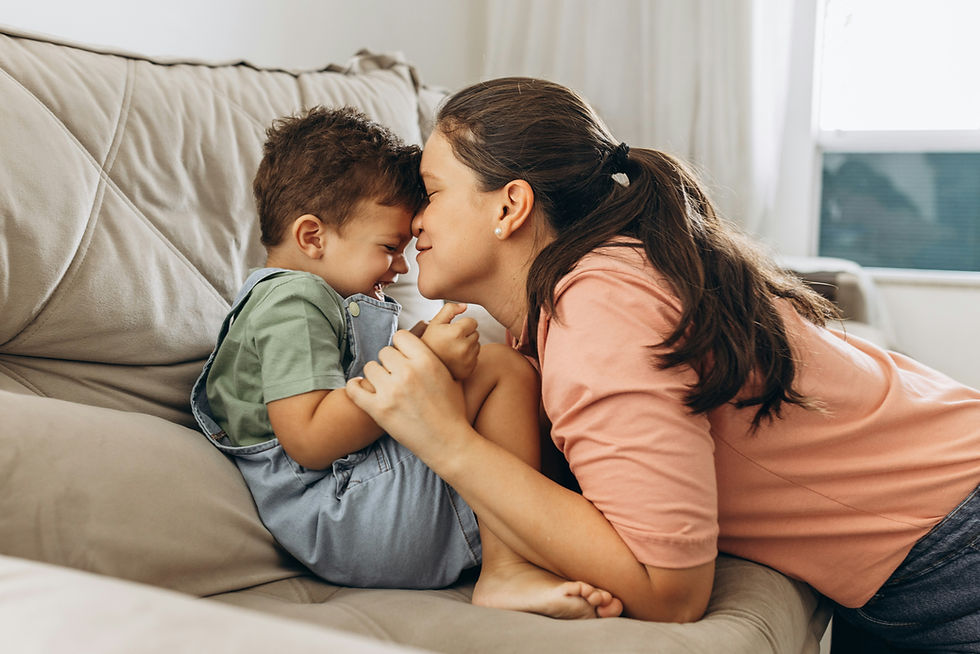
For babies, learning happens through their bodies and senses—and especially through relationships.
Research on infant language learning has found that social interaction can play an important role in how babies learn unfamiliar speech sounds. In one University of Washington I-LABS study, researchers observed babies during live sessions with Spanish-speaking tutors. Babies who more frequently shifted their attention between the tutor and the objects they were playing with showed stronger neural evidence of learning Spanish speech sounds. [3]
Babies aren’t simply absorbing a soundtrack in the background.
They are watching faces. Hearing real voices. Sharing attention. Feeling movement. Noticing repetition. Connecting an unfamiliar sound to a warm, familiar experience.
That human connection is part of the learning.
And that’s at the heart of a Mi Casa Es Tu Casa mommy-and-me class.
The Benefits They May Not Remember—but that Will Stick
Caroline started Mi Casa Es Tu Casa with both of her sons, Dash and Newt, when they were just two months old.

What first drew her in—and what has kept her coming over the years—is the welcoming, supportive space to intentionally connect with her babies while building relationships with other families.
In her words:
Even if they don't remember it… our bond will prove that what we did here at Mi Casa and the learning and the developing the ear for the Spanish language starts early.
And maybe that’s one of the most beautiful things about beginning with a newborn.
They may not remember the class. But their earliest experiences are still becoming part of them.
Music Class Isn’t Just for Your Baby. It’s for You.
Especially with your first baby, simply leaving the house can feel overwhelming;
Adjusting to shifting hormones, mastering schedules, troubleshooting what to bring in the diaper bag.
You’re tired.
Your body is recovering.

And mothers need connection, too.
Research on peer-support interventions during the perinatal period has repeatedly found benefits for maternal mental health. A systematic review and meta-analysis, for example, found that peer-support interventions can help reduce symptoms of perinatal depression.
Many times what a new mother needs is just another person who gets it.
Or a reason to leave the house.
A familiar face who notices that your baby got bigger this week.
A room where nobody cares if you need to nurse, bounce, stand, sit, arrive tired, or spend half the class soothing your baby.
Longtime Mi Casa mamá, Rebecca, found that here.
She Came for Her Baby—and Found Something She Needed for Herself

Rebecca, an educator herself, loved learning more in class about how to interact with and support her baby.
She began Mi Casa with her older son, Ethan, at just four weeks old—and later made it part of her routine again with baby Simon.
Looking back on those early days with her first baby, she says:
I knew it was good for him, but I felt like it was also really beneficial for me to come to class…I felt like it really poured into me as a new, stay-at-home mom.
That’s the part of early music classes that can be difficult to measure.
Yes, your baby is being exposed to Spanish during an extraordinary period of development, while their brain is actively listening, processing patterns, and building foundations for language. [1–3]
But while all of that is happening, you’re finding your people, too.
So, Is My Baby Too Young for Mi Casa?
If your baby mostly sleeps through class?
Come.
If they need to nurse halfway through?
Come.
If they stare at the teacher without making a single sound?
Come.
If you’re the one doing all the singing while your six-week-old looks completely unimpressed?
Come anyway. 🤍

Learning doesn’t begin when your baby can show you what they know.
It’s already happening.
And those early weeks of singing, rocking, eye contact, repetition, Spanish, movement, and simply being together are about more than preparing for a first word.
They’re about building connection from the very beginning.
A Place for Austin’s Littlest Babies—and Their Grown-Ups 🤍
Over the years, we’ve had the privilege of welcoming babies just weeks old into Mi Casa Es Tu Casa—and watching them grow from tiny babies curled against mamá into toddlers singing, signing, dancing, and finding their own voices. (some of them capable of leading an entire class at 3yo)
We’ve also watched their grown-ups grow alongside them.

That’s why being recognized by Austin families through the Best in Birth Awards as Austin's Best Baby Play Class has meant so much to us. (Nominated in 2024, Winners in 2025, nominated in 2026.)
It reflects something we care deeply about: creating a place where new parents feel just as welcomed, supported, and cared for as their babies do.
And if Mi Casa has been part of your family’s story, you’re part of ours, too. 🤍
Thank you for trusting us with these incredibly special first years—and for allowing Mi Casa Es Tu Casa to become a small part of your family’s story.
Come as you are. Bring your baby. We’ll meet you both there. 🤍
Sources
[1] Infant language developmentKuhl et al. (2006), Developmental Science. Research examining developmental changes in infants’ perception of native and non-native speech sounds during the first year of life.
[2] Music + speech processingZhao & Kuhl (2016), Proceedings of the National Academy of Sciences. Randomized musical intervention examining infants’ neural processing of musical and speech rhythms.
[3] Social interaction + second-language learningConboy, Brooks, Meltzoff & Kuhl (2015), Social Interaction in Infants' Learning of Second-Language Phonetics: An Exploration of Brain–Behavior Relations. Research examining relationships between infants’ social interaction and second-language phonetic learning.
[4] Peer support + maternal mental healthHuang et al. (2020), Journal of Affective Disorders. Systematic review and meta-analysis examining peer-support interventions and perinatal depression.
Frequently Asked Questions About Baby Music Classes
What age can babies start music classes?
Earlier than you might think! Babies can enjoy age-appropriate music experiences from birth. At Mi Casa Es Tu Casa in Austin, we've welcomed babies as young as a six weeks old. Your baby doesn't need to sit up, clap, or crawl to participate. Listening to music, feeling gentle movement, and connecting with you are all meaningful parts of the experience.
We even have a designated Bebé class just for families with babies 0-12mo.
Is my newborn too young for a mommy-and-me music class?
Not at all! Even when newborns appear to be doing very little, their brains are busy processing sounds, recognizing familiar voices, and beginning to learn patterns in language. A baby music class also gives you an opportunity to bond with your little one while connecting with other parents navigating those early months.
What are the benefits of music classes for babies?
Research suggests that interactive musical experiences can support early auditory processing, rhythm perception, and skills related to language development. Singing, movement, repetition, and face-to-face interaction also create opportunities for bonding and social connection. And the benefits aren't just for babies—music classes can offer parents a welcoming community during a major life transition.
Can babies learn Spanish before they can talk?
Absolutely! And the early exposure translates into a more native/natural accent later on. Babies begin learning about language long before they say their first words. Research shows that infants are sensitive to speech sounds and language patterns during their first year. Hearing Spanish through live singing, playful repetition, and interaction can help familiarize babies with the sounds and rhythms of the language, even before they're ready to speak.
What if my baby cries, needs to nurse, or sleeps through class?
Then your baby is being a baby! 🤍 At Mi Casa Es Tu Casa, you're welcome to feed, soothe, rock, or simply hold your little one whenever they need it. There's no pressure to participate in a particular way. And even if your baby sleeps through most of class, you're learning songs and activities you can bring home and enjoy together.
Do I need to speak Spanish to attend Mi Casa Es Tu Casa?
Not at all! Our Spanish immersion music classes are designed for families of all language backgrounds. Whether you're fluent in Spanish, learning alongside your child, or don't speak a word yet, you're welcome. Music, movement, and repetition make it easy to participate and enjoy the experience together.
Where can I find baby music classes in Austin, Texas?
Mi Casa Es Tu Casa offers Spanish immersion music classes for babies, toddlers, and their grown-ups in North Central Austin. Our classes bring families together through music, movement, and meaningful connection, creating a welcoming space where little ones and their caregivers can grow together.


Comments